Showing posts with label Administration of the forest. Show all posts

Saturday, 1 December 2012

Daily life in Medieval Sherwood Forest- Peasant Rights


Medieval society and the medieval landscape were for the common person predominantly rural and agricultural in nature.

Very little of the landscape was not utilised, and in some areas such as the ‘Champion’ (from the French champ- for field) landscapes of the Midlands, almost every inch was turned over to arable- especially in the boom years of population expanse during the 13th century.

In Sherwood Forest it was similar, in that almost every resource was used.


Every village had its great open fields, where crops were rotated through the season, and the people farmed strips of land spread throughout them. Each year one field stood fallow to recover for the following years crops.

This fallow field was fertilized by the animals of the village. Pigs and sheep would be concentrated at night into temporary pens to ‘focus’ their fertilization efforts.

Between these times it was necessary to graze animals away from the open fields.

No matter how much an animal fertilizes a field it will always take more nutrients than it returns, if it grazes exclusively from the same field that it fertilizes, as it requires nutrients to grow.

An external source of nutrients and energy was therefore required, and in Sherwood Forest this came from the great heaths and Lyngges ( Old Scandinavian for heather- see There’s Vikings in the Heather entry).

Shepherds and swineherds would tend their flocks and herds on these vast swathes of lowland heath around Sherwood Forest that stretched for mile after mile across the open countryside. Vast areas such as ‘Basforde Lyngges’, the heaths of Rufford Abbey Lordship, ‘Budby Oute Fieldes’ and the ‘Moor of Kirby’, would be dotted with these herds, and the sight of flocks and shepherds would have been common to the traveller passing through the forest.

Each parish had their own areas of woodland, usually at their edges.

In the more populated southern ‘Thorneywood’ area they occupied the high ground between parishes, such as on the ridges between the villages of Lambley, Woodborough and Calverton.

These woods often joined together to form giant woods that could cover miles, but they each had names reflecting to whom they belonged. Carleton Wode, Gedling Wode, Basforde Wode (named after villages) Kettulbarne Haw, Fox Swaht, Prior Stobyn, Samson Wode (after landscape features or owners past and present).

In the ‘High Forest’, (the northern part of Sherwood Forest) these woods were sometimes vast such as the great Maunsfelde (Mansfield) Wode, Sutton Wode, Blidworth Wood and Hay Wode, as well as the great crown woods of the Hay of Birklands, Bilhaugh and Lyndhurst Wood (see Lyndhurst Wood- the chief wood of Sherwood entry).

It is worth reminding that nobody could actually cut down the tress in these woods for timber because it was forbidden by Forest Law (see Forest Law page). However the rights to the woods were heavily guarded by the people, because they had other kinds of rights within them.

As well as the rights to pasture on the great heaths and commons peasants had the right to graze their animals in woodland at certain times of the year. One such time was the ‘Pannage’ season (just after the acorns fell) when peasant could graze their pigs on acorns in the woods of the forest.

Picutre: A peasant beating acorns from the tree for his pigs

These rights to access woods were strictly controlled under Forest Law with ‘Agisters’ acting as tax collectors to control quotas and extract fines (see Forest Law Page)

Peasants also had the right to take some smaller timber from the woods for ‘Haybote’ (hedge repair) and ‘Husbote’ (house repair).

These rights were often jealously guarded!

An Inquisition Post Mortem into the rights of the people of Clipstone Manor, dated 20th April 1327 early in the reign of Edward III shows some of the rights of the peasant to the resources of their land.

The Inquisition was presented in front of John De Crombwell Keeper of the Kings Forest beyond Trent, by the oath of John de Annesley; Philip de Caltoft, knight; Thomas Whaton; Richard Russell; Richard Ingam; John de Holm; Richard de Bestewod (Bestwood); Thomas de Lyndeby; Simon de Lameley; John le Warde of Crathethopre; William Basage; and john Moigne of Carleton…

‘The King’s tenants of his manor of Clypston in Shirwod (Sherwood), which is of ancient demesne of the crown of England, and their ancestors, tenants of the same manor, from time immemorial have been accustomed to have all ferns growing in a place which is now called the park of Clypston, for thirteen shillings and six pence, to be rendered yearly to the King’s ancestors by the hands of the justice of the Forest; and to collect the leaves fallen from the trees in the same place for manuring their lands, without rendering anything therefor; and to have pasture for all kinds of beasts in the same, doing in return the custody of the vert and venison in the same place by two of the tenants’.

This shows how the peasants had customary rights to access the ‘park’ for livestock grazing, and to gather ferns and leaves for fertilizer, (in exchange for looking after the deer and timber for the King)

It also shows that they were empowered enough to appeal through the court system to protect those rights.

The reason for the inquest is that Edward II had closed off access to the park, preventing them from their customary rights. The newly crowned Edward III was being petitioned by the men of Clipstone to have their rights returned. They also informed the King that he was losing the money they would normally pay for their rights!!!

Presumably he would be more likely to listen if his wallet was affected.

The men also pointed out that they could not get sufficient pasture outside of the park for their needs- as stated earlier nutrients for flocks and open fields needed to come from somewhere other than the fields themselves.

So as can be seen the landscape of Sherwood Forest provided opportunities for people to make their living from agriculture and from accessing the resources that the Forest provided around them. It was also the case that people would guard these rights vigorously, petitioning through the courts and to the legal system.

The laws of the land prevented many people from having many things, but they also enshrined rights over generations and the law could be called upon to protect those rights if they were threatened.

(More on farming practices in Medieval Sherwood Forest including the ‘Breck System’, and more on the courts and laws of everyday medieval life coming soon).

Friday, 19 October 2012

Magna Carta, the Forest Charter, King John and Sherwood Forest

In 1215 the Barons of England forced King John to sign the Magna Carta - the Great Charter.

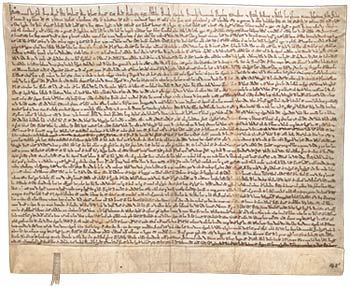
Picture: Magna Carta
This great charter was an important document which aimed to limit the powers of the king and protect the rights of the aristocracy.

Magna Carta has been influential on many constitutions written since and forms the basis of the United States Constitution.

Magna Carta contained clauses relating to Forest issues, and was followed in 1217 by a seperate 'Carta de Foresta' - the Charter of the Forest.

The Angevin Kings (Henry I, Richard the Lionheart and King John) had been very powerful since they came to power in 1154; and they had expanded royal jurisdiction across all aspects of their realm. 

Their thirst for power was manifested in their expansion of Forest law over many new areas of the country. In Nottinghamshire the Forest Law was spread across all of Nottinghamshire north and west of the River Trent (see Boundaries page).

Much to the displeasure of the local ruling classes.

The expansion of Forest law - especially in the north of England was one of the catalysts of the Baronial uprising that led to Magna Carta (Holt 1992).

In 1215 the barons had (as said) forced King John to sign Magna Carta; at Runneymead on the 10th June. 

The King signed the document, but he had little intention of yielding to its demands. He had the support of the pope who agreed that the document was improper as it had been extracted under duress. 

The pope anulled Magna Carta; and the King turned on his enemies- England was plunged into a civil war known as the First Barons' War. 

During this conflict King John is believed to have lost the crown Jewels on the coast of the 'Wash' in eastern England, before dying in the gate house at Newark Castle, Nottinghamshire in 1216.

Picture: Newark Castle gatehouse where King John died in 1216.


The Barons had replaced John with King Louis - the son of the King of France, during the conflict.

Following John's death the great general and tournament champion William Marshall persuaded the Barons to accept John's son Henry III who was crowned King in 1216.

Louis was defeated- and for all intents and purposes his reign is overlooked and even over-written in history.

There is no King Louis in the list of English and British Monarchs.

Picture: Defeat of the French at the Battle of Sandwich 1217

Magna Carta was reissued in 1216/17 this time with a seperate Charter of the Forest.

This charter was signed under William Marshall who was acting as regent to the 9 year old Henry III.

Magna Carta had contained an number of forest clauses designed to limit forest law.


These litmits on forest law were further extended in 1217 when a seperate Charter of the Forest was proclaimed.
Picture: Part of the Charter of the Forest
 
There were 17 proclamations in the charter. Including those related to removing the claws of dogs, which persons could hunt with hawks, and those allowing Bishops and other high powered folk to take a deer whilst passing through the forest.

Perhaps the most important elements were limitations on the extents of the forest, and the banning of execution and mutilation as punishments against people who killed deer in the forest.

The removal of execution, torture and maiming had a great effect on the implementation of forest law.

Over time it became more about extracting fines and levies- than removing limbs and other parts- more of a financial cash cow- valued for its contribution to the royal coffers.

Perhaps the most important impact for Sherwood Forest was the restriction it placed on the bounds of the forest.

Under Henry II and his sons Richard and John all of Nottinghamshire north and west of the Trent were forest.


The Forest Charter plunged the officials and local landowners into nearly a century of disputes over the boundaries of Sherwood Forest, that would eventually see it confined within boundaries that would then remain throughout the Medieval period (see Boundaries page).


These boundaries may well have been those of the original forest, a question still being investigated by Archaeologists and Historians to this day.


Sunday, 5 August 2012

Lyndhurst Wood- the 'chief wood of Sherwood'

Medieval Sherwood Forest was not one giant wood, but had a mixed landscape of villages with their arable fields, pasture and meadows. The forest however was chosen because it had a large amount of woodland and heath.

There were many different woods across the forest- most had names of their own.

A huge area of woodland stretched north-eastwards from Nottingham along the clay ridge now known as Mapperley tops. This wood was divided into many separately named woods belonging to all the different villages nearby (more of that later).

In the northern High forest there were also many woods such as the mighty Mansfield Wood, Kirkby wood, Haywood Oaks, and the woods of Clipstone and Edwinstowe. (these will be discussed in turn at some point).

The crown also held the two great woods of Birklands and Bilhaugh (now the Sherwood Forest National nature Reserve).

Alongside all of these was a wood described as the ‘chief wood of Sherwood’ in the Forest Book; Lyndhurst Wood (spelt Lindhurst in modern times).

Lyndhurst means ‘lime-tree wood’ suggesting that species was dominant at one time. In the medieval period it was mainly oak- used for the upkeep of Nottingham castle.
‘During the extensive works that took place at the castle between 1358 and 1368, when Stephen Romylowe was constable, a great deal of timber was taken from Lindhurst. The surviving accounts give details of the employment of carpenters and sawyers there and of the expenses of carting the timber to Nottingham.’ (Crook 1981 in bibliography). 

Lyndhurst was originally all the 'wode growing on the eesh parte (east part) of the grete (great) way that leedeth betwxyt Notynhham (Nottingham), and Maunsfeild (Mansfield) unto Sothwell rode (Southwell road) in lengith (length), and the syke (stream) of Rayewath (Rainworth Water) on the southe parte, and the valey where a syke called oulde Idle (foulevil brook- see below) hathe the course of the northe parte in lengith, is called the chieffe wode of the foresh of Shirewood (the chief Wood of Sherwood Forest)'  
As stated above the wood was defined by Rainworth Water (a tributary of the River Maun) to the south, and on its northeastern side by a stream called ‘foulevil brook’ (a tributary of Rainworth Water)- the name does not suggest it formed a natural beauty spot at the time.

The Wood was positioned to the south of the manor of Mansfield and to the north of the manor of Blidworth. The Manor of Mansfield belonged to the King, and Blidworth to the Arch-Bishop of York.

Lyndhurst was a jealously guarded property of the crown and was separate to the Manor of Mansfield.

It had its own keeper: in the 13th and early 14th century its keeper was Ralph Clere who lived in a lodge called the ‘new repair’ on its south side.

A rectangular moated site survives – sometimes called ‘Friar Tuck’s Island’ (where Robin Hood was reputedly thrown in the river in the 'Curtal Friar) at this location known as Fountain Dale, Lyndhurst. It is on the opposite side of Rainworth Water to the spring known as Friar Tuck's Well.
The site can be visited from the A60 near Harlow Wood and Thieves Wood on the road to Mansfield. 

This keeper of Lyndhurst as well as looking after the wood had the job of collecting the tax of Cheminage, a toll on carts passing through the forest, payable to his master the Keeper of Sherwood Forest (see Road Tax entry) Robert D'Everingham.


Saturday, 12 May 2012

Hanging and execution in Sherwood forest


The Forest Law in England is reknowned- even famous as being brutal:

The forest Assizes of 1184 (Henry II) and 1189 (Richard I) prescribe blinding and castration as a punishment for those who take deer or boar in the forest.

They also both state that this was the case in the time of Henry I (1100-1135)

Hanging was also considered a suitable punishment.

It can be assumed that the reputation for brutality is not unfounded; indeed the very fame of harsh forest law enforcment helped to generate and sustain the legends of Robin Hood.

However in 1215 the Barons forced King John to sign Magna Carta.

Some of the clauses of Magna Carta banned hanging and mutilation as punishment for forest offences.

The main source of records from the forest courts for Sherwood come from the Forest Eyres of 1287 and 1334 (see 1287 Sherwood Forest Eyre Court and 1334 Sherwood Forest Eyre Court entries for more details).

Both of which were a considerable time after Magna Carta.

As a result- no accounts of hangings directly related to Forest Law offences survive for Medieval Sherwood Forest.

There are a number of accounts of imprisonment, and of people being outlawed- for poaching deer (see Poaching in Clipstone Park in 1279 and Forest Law Outlaws entries for more details).

Despite this, hanging did occur in Sherwood Forest throughout the medieval period for other offences:

Namely theft of property- and these were infringments against the common law.

The Borough Records for Nottingham show that in 1315-16 Gervase Aubrey, of Wilford, was captured in the town of Nottingham with a cow stolen from Henry de Gedling... 

...not exactly something you could hide up your coat!

He was brought before the jury and found guilty, and therefore 'Ideo suspendatur- (let him be hung)!'

Also, this time on the 2nd June 1316: Walter le Shepherd, of Sallow, was taken at Nottingham with 11 sheep stolen in the field of Nottingham, from a Henry de Wollaton...

Amazing... presumably a larger coat would be needed to conceal 11 sheep!

Walter was unsuprisingly found guilty and therefore again 'Ideo suspendatur- (let him be hanged!)...

These hangings presumably took place on the town gallows for Nottingham.

These were situated on a sandstone ridge on the side of the King's Highway to York, north of the town walls and its great open fields. 

They Loomed large over the town as a symbol of power and justice.

It was not just in Nottingham that hangings occured in the forest:

They also took place in the King's Manor of Mansfield to the north.

'On Thursday 10th June 1316... Geoffrey son of Roger of Walesby was arrested in Mansfield with a green surcoat worth 4s. He would not say how he came by it, but Maud daughter of Henry le Thacker of Mansfield said that it was hers and that it had been stolen at the house of Richard Alche of Mansfield. Geoffrey denied it and put himself on a jury of twelve local men who found him guilty. He was sentenced to be hanged...

...Another criminal, guilty of a similar offence a few years later, was more fortunate. In 1319-20 Richard son of Richard of Ireland of Mansfield admitted he was guilty of stealing a horse worth 10s. in the fields of Mansfield, but he did not do so until he was safely in the sanctuary of St. Peter's Church. He abjured the realm, thus leaving the country for good in order to save his life' (Crook 1985).

The gallows for the Crown Manor of Mansfield stood on the side of the road from Nottingham to Mansfield, south of the town. (Interestingly in modern day 'Thieves Wood').

Again this was a very potent sign of royal justice and power to anyone entering the manor.

The hill on which they stood is listed as 'galow tre hyl' on a medieval map of Sherwood Forest (see Gallows in the forest? entry)

Abjuring the realm was a common way of avoiding the gallows and many criminals convicted of theft in Nottingham were given the sentence of 'abjuring the town' when their crimes did not quite warrant hanging.

As well as these sentences of hanging for theft a more curious entry in the Chamberlains Accounts for 1485-6 lists the hanging of 3 monks of Lenton Priory on the gallows of Nottingham although nothing of their crime is listed (Records of the Borough of Nottingham Vol III 1485-1547, page xix).

Perhaps the most notorious hanging in Nottingham in the Medieval period is that of the last Prior of Lenton.

As part of the attempt by Henry VIII to seize monastic land, the prior of Lenton was arrested for treason and thrown into prison in 1538.

In March 1538, Prior Nicholas Heath was hanged, drawn and quartered in Nottingham- his mulitalted body was displayed as a warning to other religious houses, at the gate of the priory.

This violent act brought to an end the priory of Lenton and its spiritual domination of the town.

This execution must have had a massive impact in the town. The priory had been at the heart of life in Nottingham, its annual fair was famous around the land, and the great towers of the Priory could be seen for miles across the floodplain of the River Trent.

So momentous was this act that it could be argued it was one of the moments, along with the dissolution of the monasteries at Rufford and Newstead that signalled the end of the Middle Ages in Nottingham and Sherwood Forest.

The gallows can be seen then, to have had an impact over peoples lives throughout the medieval period- and although no records survive for their use  in Forest Adminstration- their use and their presence clearly had a significant role in the administration and life of medieval Sherwood Forest.

More to come on the courts, crimes and punishments in medieval Sherwood Forest soon).


Tuesday, 20 March 2012

Queen Joan and the keepership of Sherwood Forest

Queen Joan was the second wife of Henry IV (1399-1413) of England.


She was born the daughter of Charles II (the bad) of Navarre and Joan of Valois.

Her grandfather was John (the good), King of France (the second King of the house of Valois).

The Hundred Years War which ran from 1337 to 1453, was the dynastic struggle for the throne of France between the English Plantaganet dynasty and the French House of Valois. With both houses claiming the French throne.

Henry IV had seized the throne of England from Richard II in 1399, and married Joan in 1403.

You would think such a link between the royal houses would help to bring about peace- it didnt of course- it never did!

She ruled as Queen of England until her husbands death in 1413.

Her step son Henry V accused and convicted her in 1419 of witchcraft.

Following a four year spell in Pevseney Castle she spent the remainder of her time living in Nottingham Castle.
There she seems to have assumed some of the rights of the Keepership of Sherwood Forest during that time.

Back in the times of Hereditary Keepership, the De Caux and D'Everingham families, based at Laxton Castle, had had a number of rights through their office, which they held from Norman times until 1287 (see Women Keepers of Sherwood Forest entry), when the keepership was lost by Robert Everingham for poaching.

Amongst these right and privileges, was the right of Chiminage - the right to collect taxation from carts travelling through the forest (see Road tax entry).

A record in the Court rolls for Nottingham from 1431 lists an 'Action by Queen Joan for ferm of Chiminage of Sherwood Forest':

'Johanna, Regina Angliae , per Galfridum Kneton, et Robertum Clapam, attornatos sous, queritur de Thoma Bayle, de Notingham, [de placito] debiti vjs. viijd'.

'Joan, Queen of England, by Geoffrey Kneveton, and Robert Clapham her attourneys complains of Thomas Bayle of Nottingham, [of a plea] of debt of 6s 8d'.

She claimed that Thomas Bale took from her the Chiminage of the Forest of Sherwood at the feast of St Martin in the 9th year of Henry V until the same feast a year later- the money should have been repaid by the feast of 'All Hallows' in the 10th year of Henry V, but had not been. This amounted to 6s and 8d...

In fact he refused to pay her it.. and so she brought a claim to the court for the money.

As well as the right of Chiminage, she also seems to have upheld the forest laws regarding the 'hambling of dogs' in the forest (dogs in the forest had to have their claws removed to prevent hunting (see Forest Law page)):

An 'action by Queen Joan for the ferm of the Hambling of Dogs within Sherwood Forest', dated 29 October 1433 was brought before the Nottingham court:

The claim presented that a Thomas Rothewood withheld from Queen Joan and Geoffrey Kneveton the rents from the hambling of dogs within the Forest of Sherwood (pro redditu expeditationis canum infra Forestam de Shyrewode).

It is claimed in the case that Thomas owed 12d for the rent.

Her counterpart in these claims is one Geoffrey Kneveton- who was actually Constable of Nottingham Castle.

The office of Keeper of Sherwood Forest and that of the Constable of Nottingham castle was brought together following the demise of the D'Everingham dynasty's hereditary claim to keepership of the forest (as stated above)...

Perhaps with a member of the royal family also living at the castle alongside the Constable, these roles became blurred, with Queen Joan assuming some of the powers of Keeper of the Forest of Sherwood for herself...

Thursday, 15 March 2012

The Butcher, the Bacon and Bestwood: Trespass in Bestwood Park in 1440

Bestwood Park was the largest Royal Deer Park in Sherwood Forest - see Bestwood Park entry for more details), 

On Janurary 16th 1440, an 'action by Ralph, Lord Cromwell, for breach of Bestwood Park', was brought before the Nottingham Court...


The inquest begins:

'Radulphus, Dominus de Crumwell, myles (Ralph Lord of Cromwell, knight), complains of William Fisher, of Nottingham, butcher, in a plea of trespass against the peace of our lord the present King...

...And whereupon he says, by his attornies William Alwin and John Morton, that the aforesaid William, together with others, on Tursday next after the feast of All Hallows, in the 19th year of the reign of king Henry VI, here at Nottingham, with force and arms, to wit, with a club, drove four hogs (porcos) put and arrested for pannage within the Park of Bestwood out of the park aforesaid, and broke the park aforesaid... to the cost of 20s...' 
William presented himself to the court to show he was innocent... 

Unfortunately there is no follow up to the case, so it is not certain of the outcome of the trial.

What is strange is that this is not poaching in the normal sense.

These are not the Kings deer, and the butcher was not hunting with a bow.

He went in to the park, broke the park pale (three metre high fence) down, and stole four pigs who were grazing within - using a club.

Clearly Bacon was not easy to come by for his butchers shop at that time...

The pigs were grazing in the park legitimately under the pannage system.

Pannage was a common right for peasants who were allowed to graze their pigs in the woods of the forest when the acorns fell and for a period of time after. This season was decided at the Verderers Court (see Forest Law page for more details) and the numbers of pigs were monitored by Agisters who acted as tax collectors. 

This entry shows that with the demise of the Forest Eyre Courts by the time of 1440 (see 1287 Sherwood Forest Eyre Court and 1334 Sherwood Forest Eyre Court entries); how breaches of the forest law were dealt with.

The Keeper of the Forest here brought complaint before the Nottingham Court to gain the money back from the accused, caused by the trespass and damage to the park.

Ralph Cromwell was Keeper of Sherwood Forest and Constable of Nottingham Castle as appointed by King Henry VI in 1437. He held land and a manor house at Lambley- and may also have been the man for whom the Belvoir Map of Sherwood Forest was made (see Oldest map of Medieval Sherwood Forest).

Monday, 12 March 2012

the Melee and Jousting: Tournaments in Medieval Sherwood Forest


Picture: The Medieval Melee
In 1194 Richard the Lionheart gave a licence to hold tournaments to five locations in England. Interestingly for our story one of those was at Blyth in Nottinghamshire.

In the 12th century when this royal Licence was granted Blyth was within the Royal Forests of Nottinghamshire.

King Richard had to bring about this act because his father Henry II had made tournaments illegal.

He saw them as a source of disorder.

Bunches of heavily armed testosterone fueled young men running around armed to the teeth was not regarded as a sensible idea by Henry II: desperate to restore order to England after 20 years of civil war.

Unlike his father, King Richard I saw the tournament as the best way to train men for combat.

They rapidly became a method for skilled and ambitious men to become rich and famous, and tournaments were held across the continent.

The original tournaments were based on the melee, where large numbers of knights would fight as individuals or in teams- on horse or on foot.

The fights were not for fun, they were treated like real battles, and combatants who were captured were ransomed

This meant plenty of money could be made by the would be champion.

Perhaps the greatest Knight of his age, William Marshall the later Earl of Pembroke-  rose through the ranks at the tournaments to become firstly the tournament captain for Henry II's son (Henry the Young King), then after winning his fortune around the tournament fields of France and England he managed a short spell on crusade in the holy land,  became the trusted servant and general of King Richard I and King John, before being made Earl of Pembroke and then the Regent of England for the young Henry III in 1216.

In this role he helped defeat Louis of France who had made claim to the English throne- leading the charge at the 2nd Battle of Lincoln in 1216 aged in his seventies.

He oversaw the sealing of the Magna Charta in 1215, and then brought into being the separate Chater of the Forest in 1217- that would have a great impact on the boundaries and rules of Medieval Sherwood Forest (more soon).

Quite a life by anyones standards!

He became a Templar Knight on his deathbed and is buried in the Temple Church in London.

It was the opportunity of the tournament field that gave him his start on the road to greatness. It was a road that through Magna Charta, and the subsequent Forest Charter would have a great impact on Medieval Sherwood Forest (more soon- see boundaries page for some information).

Picture: William Marshall in a tournament

These original tournaments became the testing ground for Knights across Europe.

The tournament melee could seem a disorganised affair- but in the hands of such tournament captains’; great skill and ingenuity was employed to bring glory on the field.

Melees were incredibly violent, and injury a likely occurrence- William Marshall’s helmet was so badly dented on one occasion he could not take it off. When they wanted to present him with his prize he was eventually found with his head on the blacksmith’s anvil having the dents beaten out of his helmet by the blacksmiths hammer; so he could remove it!!! (Jones 2007).

In the forests of Nottingham it was at Blyth in these earlier days that these tournaments were held.

Blyth was in the Hatfield District of the Wapentake (Hundred district) of Bassetlaw in North Nottinghamshire.

An expanse of natural heath (Hatfield means heath field), it was an area obviously suited to a royal forest.

Blyth was in the forest by at least 1100, and remained so until 1218.

It may have been in the forest since soon after the conquest, but the boundary at that time is not fully known.

Blyth belonged at Domesday to the great baron Roger De Bully whose land holdings were based on the castle of Tickhill about four miles to the north.

This grouping of lands was therefore known as the ‘Honour of Tickhill’.

These lands defaulted to the crown in 1100 when Roger’s successor Roger Belleme fought on the wrong side during Henry I’s campaign to regain his Norman possessions.

With the honour of Tickhill in crown hands forest law seems to have spread over the area.

The Historic Environment Record (HER) for Nottinghamshire lists ‘Raker Field’ to the south of the village of Styrupp near Blyth as the tournament field- but this is disputed- certainly it would be small- as melee fields could be up to three miles across.

But it is in the right area: in his ‘A History of Nottinghamshire’ Cornelius Brown wrote in 1891:

‘A level tract of land between Blyth and Styrrup was the locality where feats of horsemanship took place, in which the flower of English chivalry sometimes under the personal patronage of royalty itself. We can well imagine the animated scenes that must have occurred at these war-like gatherings... Many allusions are made in the Close Rolls to the Blyth meeting, which continued till the end of the sixteenth century, when popular taste began to change and tournaments became but a reminiscence of the past’.

So it seems that tournaments at Blyth were a common feature throughout the period.

Public tastes did indeed change, and the tournament evolved through the medieval period.

Melees often started with a joust where protagonists would charge at each other in an attempt to unseat the opponent or ‘tilt’ him from his horse. Once this had happened the melee would ensue.

The statute of Arms of Edward I in 1292 brought in the use of blunt weapons in the tournament. By this time jousting had begun to take over in popularity from tournament fighting via the melee.

Picture: Medieval Joust
The joust would take chivalrous spectacle to new levels. It is this method of contest that is the most familiar to us from the medieval tournament.

In 1334 Edward III held a tournament in Nottingham in Sherwood Forest.

Perhaps to tie in with the Forest Eyre court held in that year (see the 1334 Sherwood Forest Eyre Court entry for more details).

No description of the affair survives, but a near contemporary description survives for a joust and tournament, and it sounds like a spectacular affair:

‘When the earls, barons, and a great number of ladies had gathered on the Sunday, January 19, the king gave a solemn feast and the great hall of the castle was filled by the ladies... At this great gathering there were two queens, nine countesses, the wives of barons, knights and citizens, whom they could not easily count... in tents and other places, where food and all other necessities had been prepared; everything was on a generous scale and served unstinting... In the evening dancing and various entertainments were laid on in magnificent fashion. For three days following, the king with nineteen other knights held jousts against all comers; and the king himself, not because of his kingly rank but because of his great exertions and the good fortune that he had during the three days, was held to be the best of the defenders’.  Adam of Murimuth 1344 (Munby et al 2008).

This description of tournament comes from Edward III’s Round Table Feast where he founded an 'Order of the Round Table' based on the legends of King Arthur.

This order of the Round Table would be reduced later in his reign into the 'Order of the Garter' which survives to this day.

The joust and the tournament had moved from a training place for young knights in blood thirsty melees to the height of the chivalric ideal.

In Sherwood Forest the tournaments at Blyth and Nottingham were part of this embodiment of knightly virtues.

Alongside the archery training and tournaments that are the stuff of the legends of Robin Hood in Sherwood Forest- the pursuit of the common freeman- (see Archery in the Forest entry for more details) there were also knightly tournaments of both the early melee and later jousting traditions in Sherwood Forest.

As stated above, at Blyth there are accounts of tournaments throughout the medieval period, showing how popular this form of entertainment was to the upper echelons of society in the medieval period, and how it formed a colourful and glamorous part of the story of Medieval Sherwood Forest.

(more to come on chivalry, knighthood and military service, as well as knightly outlaws in the medieval forest)

Saturday, 11 February 2012

1287 Sherwood Forest Eyre Court


The 1287 Sherwood Forest Eyre Court took place on the morning of the feast of St Hilary (January 13th)in Nottingham.


Pleas of the Forest were heard before Sirs William De Vescy, Thomas de Normanvillle, and Richard de Creeping- Justices in Eyre of the Lord King for pleas in Sherwood Forest.

They were also heard before the Verders (viridarios) (see Forest Law page) of the Forest:

Richard de Jort, William of Colwick, John of Annesley, Henry of Tinsley, William of Bevercotes and Ralph the Clerk of Mansfield (clericum de Mammesfeld).

And Foresters (forestarios):

Robert D’Everingham forester in fee (forestarium feodi)- Keeper of the Forest, and under him Richard of Coningeston, his attourney, Robert the Tailor, Hugh Flambard, William the fisher (Willelmum Piscarium), Willialm of Durham, Adam of York (Ebor- from Latin Eboracum – York), Robert de Strelley, William be Blakeburn, the sworn foresters of Robert D’Everingham.

Walter of Winkburn the attourney of the justice of the forest , and under him William of Hastings, William de Sheffield (Schaffeud), William the Welshman (Waleys), Robert of Linby, Bate of Linby, Hugh of Mansfield and Henry son of Richard of Clipstone.

The court opened and heard a number of cases of trespass against the venison- poaching deer:  these can be seen in Forest Law Outlaws and Poaching in Clipstone Park in 1279 entries.

The court then proceeded to set out the following points:

1.       The Verderers of Sherwood are to hold their court  every 40 days into the small infringments against the vert (cutting down trees) and small pleas – as stated int the Charter of the Forest

(the great charter of Magna Carta was first signed in 1215, it was followed by a seperate Charter of the Forest in 1217 - more soon). They were to present their findings on two court rolls to the Eyre- one for Vert and one for venison (see Forest Law page).

Picture: the 1217 Charter of the Forest

It seem the Justices in Eyre and the King believed that the local justices (verderers) were failing in their duties in upholding Forest Law.

2.       All the demense woods of the lord king (bosci domini regis - woods owned by the crown) and his enclosures and parks (haye et parci) were to be guarded as to the vert, that if anyone who lives in the forest is found felling a green oak he is to be forced to attend the said verderers court and there provide enough pledges till the next forest eyre (a person had to find somebody who could guarantee that they would attend by pledging money if they didn’t – that person would then force the attedance of the accused if necesssary to guarantee their presence).
His Mainour (that which he stole) is to be appraised by the foresters and verders and he is to pay the amount it was worth to the verderers.
If a person is caught a second time trespassing against the vert- the same will happen.
If a person is caught a third time they will be locked up safely in the prison of the lord King at Nottingham until they can be brought before the justices in Eyre.

Being locked up was no relaxing time- medieval prisons were harsh places with no food provided (a person relied on food brought from outside) and very poor sanitation- well often no sanitation.

The forest Eyres were not exactly regular so a wait at his majesty’s pleasure was not exactly pleasurable- and you could be in for a long wait!!

This may seem bad enough- but at least if you lived in the forest you had three strikes before you were sent to gaol.

It was different for those living outside:

3.       Anyone dwelling outside the forest caught felling trees in the demense woods of the lord King also had to pay the amount it was deemed to be worth
His body was then to be submitted to  prison (corpus suum committatur prisone) until he can be brought before the justices of the forest.
Strike one- Prison.
If he is found a second time then the same will happen.
If he is found trespassing against the vert for a third time he is to lose his horses with his cart, or his oxen with his waggon, or their price; and that price must be paid in full at the next verderers court  or to the neighbouring township for the use of the lord king , so that the verderer or his heirs or the township may answer therefore to the lord king before the justices in Eyre.

Presumbaly losing a horse and cart or an oxen and wagon was almost terminal for your average medieval peasant!

4.       If a person who lived in the forest was found taking small sapplings below the value of four pence they were to be tried before the verderes- over four pence they were to be sent to the forest Eyre.

This entry lists ‘cutting saplings, branches or dry wood from oaks or hazels or thorns or a lime or an alder or a holly or such like trees...’

There are not many references to the types of trees available to peasants on the ground in the forest- different woods burn at different intensities either slow or fast and would be needed for different kinds of cooking and heating, they also had different properties for building houses and hedges- this gives us a glimpse of some of the trees and sapplings being used, and we can begin to think about their uses for the medieval peasant.

Entries 5 and 7 discuss the fines for escaping beasts of the plough (escapia aueriorium) which ended up in the woods of the king causing damage there.

Entry 6 states that ‘it is provided that no man in the future carry bows and arrows (arcus vel sagittas) in the forest outside the king’s highway, unless he is a sworn forester (forestarius iuratus).

The remaining entries list responsibilities of the regarders (those who check the boundaries) and foresters with regard to trespass in wood not belonging to the crown.

The forest Eyre of 1287 then, gives us a great insight into the adminsitration of Sherwood Forest and the application of Forest Law and its impact on the lives of the people in and around Medieval Sherwood Forest.

(For more informtion on the Forest Law see Forest Laws Page and 1334 Sherwood Forest Eyre Court entry).

Pleas taken from: Turner G.J., 1901. Select Pleas of the Forest. Seldon Society.

Wednesday, 1 February 2012

the Archbishop of York and Sherwood Forest

During the medieval period the religious life of Nottinghamshire and Sherwood Forest was influenced by the many religious houses and churches, spread throughout the landscape.

Picture: Southwell Minster
The church was intrinsic to everyday life, its festivals and feast days followed the seasons of the year, its saint days were used to document the meetings of the courts and administration of the land, and the church protected and legitimised the role of the monarchy itself.

The church in England was until the reformation of the 16th century part of the great Catholic Church under the control of the papacy in Rome.

The leader of the church in medieval England was the Archbishop of Canterbury, who held the office of St Augustine, since the 6th century.

In the north of England however it was the Archbishop of York who held sway over the lives and souls of the people.

In Nottinghamshire the Archbishop held a great amount of power both spiritually and temporally.

In Domesday he is listed as having full jurisdiction and market rights and the King’s customary dues of two pence over his manors.

The Archbishop is the fifth landowner listed in Domesday for Nottinghamshire behind the King and a small number of Counts and Earls.

The Domesday Posessions of the Archbishop include the Manors of Cropwell (Bishop), Laneham, South Muskham, Blidworth, Oxton, Norwell and Sutton with its outliers of Lound and Srooby, and in the great Manor of Southwell in central Nottinghamshire. The Archbishop also held land in other places including Woodborough (Morris 1977).

Blidworth and Woodborough were both within the boundaries of Sherwood Forest.

The rest of the Archbishops properties were outside the 13th century boundary of Sherwood Forest, but the Archbishop was subject to forest law in many of his lands. His influence may even have affected the forest boundaries over time.

Sutton, Scrooby and Lound in north Nottinghamshire were granted by charter to the Archbishop, then called Oskytell, by King Edgar of England in the year 958 (Davies T.GT. 1983).

Interestingly this charter mentions a ‘scirwuda’ (shire wood) as part of the boundary perambulation of the estate. This is often cited as the earliest reference to Sherwood Forest, but sadly it cannot be directly linked to the Forest of Sherwood, due to its location, and a separation of nearly 300 years in the use of the name.

Scrooby was also incidentally later the home of William Brewster a leader of the Pilgrim Fathers who sailed to America on the Mayflower.

In a charter in 956 two years before Sutton, Lound and Scrooby were granted to the Archbishop Oskytell, King Edgar's brother the preceeding King Eadwig had granted the Manor of Southwell to the Archbishop.

Southwell became the heart of the Archbishop’s power in the county.

With all its outliers the Manor of Southwell became an incredibly well defined area of power belonging to the Archbishop .

At the centre of this estate was the Minster church of Southwell.

Southwell Minster operated as a collegiate of secular canons.

This was effectively a collection of religious brothers similar to a monastery- the term secular means they were not tied to one of the religious orders of the day.

Each of these canons provided religious service to surrounding communities known as ‘Prebeneds’ in exchange for land and money.

By the 1290’s Southwell had acquired 16 Prebends in the surrounding area some of them in lands they had possessed since Domesday and some aquired overtime.

These were at The Sacrists' prebend, Normanton, Woodborough, North Muskham,South Muskham, Dunham, Beckingham, Halloughton, Rampton, Eaton, and North Leverton, three Prebends at Norwell, and two at Oxton (Page 1910 Victoria County History).

The dominion and jurisdiction the Archbishop had over the lands around Southwell resulted in it being known as the ‘Southwell Peculiar’.

The above is a short introduction to the relationship of the Archbishopric to the land and people of Nottinghamshire.

So what does this all have to do with Sherwood Forest?

The Archbishop of York held the manor of Blidworth, and the Prebend of Woodborough, both in Sherwood Forest as defined by the 13th century perambulations.

At Blidworth he was confirmed in an inquisition of 1155/6 as having the right to ‘hunt in his wood of Blidworth for nine days a year, three each at Christmas, Easter and Pentecost. There he, his canons and his men had all their easements without waste, their own foresters, honey, eyries of sparrowhawks and hawks and pannage’ (Crook 1994).

Also as a leader of the church his lands were protected with regard to  trespass against the forest law by threat of excommunication (see Mutilation and Damnation entry)

In 1300 the forest boundary was perambulated at the order of Edward I. The boundary was altered to allow the Archbishops wood at Blidworth to be exempt from the forest law (Boulton 1964). This wood was known as ‘ye Bischopes Wode’ in the 1400’s, and sat at the northern boundary of Blidworth against the lordship of the Abbots of Rufford (see A journey through Sherwood Forest: Newstead Priory to King John's Palace).

The remainder of the Archbishop’s lands were outside the boundary of Sherwood Forest at this time.

There were however many issues regarding the Archbishop and the forest.

An inquest in 1155/6 at the start of the reign of Henry II (1154-1189) into the rights of the Archbishop of York in relation to the forest law in Nottinghamshire in the reign of his grandfather Henry I (1100-1135) gives us our earliest known boundary of the forest in  Nottinghamshire (see Oldest known boundary entry).

This ‘Old Forest’ as the inquest calls it, in the time of Henry I, stretched all the way up the western half of the county. The documents refer to this forest as the 'Forest of Nottingham'.

The Archbishop’s lands were exempt from the forest law to the east of this line in the time of Henry I because they were outside of the forest.

In the reign of Henry I’s grandson, Henry II (1154-1189), and his sons, Richard I (1189-1199) and King John (1199-1216) all of Nottinghamshire north and west of the Trent was subject to forest law.

This meant that all of the Archbishop’s lands in the area to the east of the 'old forest' were subject to forest law.

As forest law gradually engulfed all of Nottinghamshire north and west of the Trent during the reign Henry II, Richard I and John, the area to the east of the Forest of Nottingham came under forest law. This area seems to have gone by the name ‘Forest of Clay’

The boundary between the two forests was defined by the boundary of the ‘Old Forest’ of Henry I, and reflects mainly the geology and soils of the region (see Forest of Clay entry). But effectively the crown administered this huge area as one forest.

The crown enforced forest law in the Forest of Clay as it did in the Forest of Nottingham throughout the later 12th and early 13th century:

In 1167 the Canons of Southwell and the collegiate church were fined by Henry II ‘the men of Norwell “of the part of Master Viacrius’ paid half a mark as a result of the forest Eyre of Alain de Neville”’ (Crook 1994)

This seems to relate to one of the Prebends of Southwell in Norwell in the Forest of Clay.

In 1185 Vicarius was ‘charged with 40s for waste of his wood and trespass against the assize, in the forest eyre of Geoffrey Fitzpeter’ (ibid.) along with Andrew the canon charged 100s, Geoffrey the canon 2 marks, and Master Gilbert 2 marks- most likely all canons of Southwell.

‘Two years later, in another Eyre by Geoffrey Fitzpeter, Andrew canon of Southwell was amerced the enormous sum of 40 marks for receiving venison and removing it contrary to the assize. At the same time Master Vicarius was again charged with 2 marks for trespass against the assize, canons Gilbert and Laurence 40s each for the same offence and for default… 

...it was probably the 1187 forest eyre which led Hugh of Avalon, the saintly bishop of Lincoln to excommunicate Geoffrey Fitzpeter for enforcing the forest law’ against the Archbishops men (Crook 1994).

In the time of Richard I (1189-99) it seemed that things had got better for the Archbishop, when in 1189 Richard granted the Archbishop ‘disaforestment of all the lands of the church of York in Nottinghamshire, both those held in demesne and those in the prebends. They were quit of all wastes and assarts and pleas of the forest, and of the regard, and no forester or other bailiff was to interfere with them’ (Crook 1994).

However the archbishop's men still got fined or bought their way out of fines in 1198 and 1209 at the forest eyres, suggesting that the charter of Richard meant little.

The fact that they were being directly fined for forest infringements suggests that royal forest law applied over all of Nottinghamshire north and West of the Trent, and the Archbishops land at Southwell in the Forest of Clay.

When King John was in control of Nottinghamshire as Count of Mortain between 1189 and 1194 he confirmed that Maud de Caux was keeper of the Forests of Nottingham and Derbyshire (see Women Keepers of Sherwood Forest).

In 1222 Maud de Caux was referred to as the keeper of the Forests of Nottingham and of Clay’ (Crook 1979).

Also Brian De Lisle as Chief Justice of the Forest was ordered to allow Walter de Evermue to take timber from Clay as well as Sherwood to repair his houses (ibid).

This suggest that the crown continued to have jurisdiction over the Forest of Clay into the 13th century, possibly up until the boundaries of the forest were finally agreed in 1227.

The crown seems then to have maintained control over the forest of Clay in the reigns of Henry II, Richard I and John up until 1227 in the reign of Henry III, with the Archbishop’s men being some of the victims of this policy.

The boundaries of the Sherwood Forest were reduced following Magna Carta and the subsequent Forest Charter.

This new area removed the Forest of Clay from the equation, as the forest retreated into an area that may or may not have been the original forest (see Castles and Sherwood Forest entry), which may have fallen within the jurisdiction of Nottingham Castle.

This meant that the problems the Archbishop of York had had regarding the forest had been finally resolved.

As previously stated the condition improved further when the boundary was altered by Edward I in 1300 to allow his forest at Blidworth to be exempt too.

It could be that the area of jurisdiction that the Archbishop of York had around Southwell was one of the reasons for the strange shape of Sherwood Forest from the 13th century when it retreated into a boundary from an earlier time.

Perhaps the Doverbeck River provided a natural boundary between the jurisdiction of the castle of Nottingham (and therefore the original boundary of the forest) and the jurisdiction of the Archbishop of York to the east of it. 

It is not possible to know for sure if this was the case, with the evidence known at the moment.

But it is clear that the Archbishop of York was an important figure in the lives of the people of the time, and that he held significant authority in the county. It is clear that the Archbishops' faced the authority of the forest law as did everyone else- often despite their exemptions from it. It seems that over time they eventually managed to remove the majority of their lands from under forest law, and it is also possible that their influence even helped shape the original boundary of Medieval Sherwood Forest.

(More on Bishops, Archbishops the church and everyday life and the church and the forest law soon).